How to Create Educational eBooks for Coaches & Consultants: The Complete 2026 Guide
title: "How to Create Educational eBooks for Coaches & Consultants: The Complete 2026 Guide" description: "Create high-converting educational eBooks that attract premium coaching clients. Complete guide with templates, examples, and strategies that fill your pipeline."
How to Create Educational eBooks for Coaches & Consultants: The Complete 2026 Guide
As a coach or consultant, your expertise is your currency. Educational eBooks are how you demonstrate that expertise at scale—attracting qualified leads while you sleep.
This guide shows you exactly how to create educational eBooks that position you as the go-to expert and fill your calendar with high-ticket clients.
Why Coaches & Consultants Need Educational eBooks
Coaches and consultants face a unique challenge: people need to trust your expertise before they'll invest $3,000-15,000+ in your services.
Educational eBooks solve this by:
- Demonstrating deep expertise without giving away your entire methodology
- Pre-qualifying leads by attracting people who value learning and growth
- Building trust before the first conversation so calls are easier
- Creating passive lead flow that works 24/7 while you focus on clients
- Establishing thought leadership in your niche
The Lead Generation Challenge
The coaching and consulting market is saturated. Potential clients are bombarded with content from hundreds of experts.
Trust is the bottleneck. Prospects need proof you understand their situation and have helped others succeed.
Time is limited. You can't spend all day creating content—you need systems that work while you're delivering client results.
Key Statistics:
- 78% of buyers want to work with advisors who demonstrate thought leadership (Edelman)
- Educational content generates 3x more leads than paid advertising for professional services (HubSpot)
- Coaches using lead magnets report 2.7x higher conversion rates than those relying solely on discovery calls (Coach Foundation)
Understanding Your Coaches & Consultants Audience
Demographics & Psychographics
Your ideal client:
- Age: 35-55 (established in career/business)
- Income: $100K+ (can afford coaching)
- Mindset: Growth-oriented, invested in development
- Behavior: Researches extensively before buying
- Pain: Stuck at current level, seeking breakthrough
- Timeline: 2-8 weeks from awareness to purchase
Pain Points & Goals
Top Challenges:
- Overwhelmed by Options - Too many coaches and consultants claim the same expertise. Buyers struggle to differentiate quality from hype.
- Fear of Wrong Investment - Coaching is expensive and intangible. Buyers worry about wasting money on someone who can't deliver results.
- Proving ROI to Themselves (or Spouse/Partner) - Justifying a $10K coaching investment requires confidence in the transformation. Educational content builds that confidence.
Primary Goals:
- Find a proven expert who understands their specific situation
- De-risk the investment with evidence of expertise
- See a clear path from where they are to where they want to be
The Educational eBook Format for Coaches & Consultants
What Makes It Effective
Educational eBooks work exceptionally well for coaches because:
They demonstrate without depleting - You show what you know without doing the actual coaching
They filter for commitment - People who invest 30-60 minutes reading are more serious than those who just watch a 5-minute video
They create reciprocity - When you provide substantial value upfront, prospects feel compelled to engage
They establish your framework - Your unique methodology becomes clear, differentiating you from competitors
Structure That Converts
Proven Outline:
Introduction (Pages 1-3)
- Your credibility & background
- Who this is for (and who it's not for)
- What they'll learn
- Your unique framework preview

Part 1: The Problem (Pages 4-8)
- Current state analysis
- Why traditional approaches fail
- Hidden obstacles
- Cost of staying stuck

Part 2: The Framework (Pages 9-20)
- Your unique methodology
- Phase 1: [First step]
- Phase 2: [Second step]
- Phase 3: [Third step]
- Phase 4: [Fourth step]

Part 3: Implementation (Pages 21-28)
- Getting started
- Common obstacles & solutions
- Success timeline
- Support structures needed

Part 4: Transformation (Pages 29-33)
- Case study examples
- Before & after states
- What changes in each phase

Conclusion & Next Steps (Pages 34-35)
- Recap of key insights
- DIY path vs. guided path
- Invitation to work together
Length & Depth Recommendations
Optimal length: 30-40 pages
Why this works:
- Substantial enough to demonstrate deep expertise (not a fluff piece)
- Completable in one sitting (30-45 minutes)
- Long enough to build trust and connection
- Short enough that people actually finish it
Red flags:
- Under 20 pages: Feels thin, doesn't build enough trust
- Over 50 pages: Most won't finish, feels overwhelming
Format preferences:
- Mix of text, graphics, exercises
- Conversational tone (not academic)
- Generous white space
- Pull quotes and key takeaways highlighted
- Actionable without being a complete DIY solution
Step 1: Research & Planning
Topic Selection
Choose topics where you can provide unique perspective or methodology, not just general advice.
Bad topics:
- "How to Be More Productive" (too generic)
- "Leadership 101" (not unique)
- "The Secret to Success" (vague)
Good topics:
- "The 90-Day CEO Reset: How Burned-Out Leaders Reclaim Energy and Vision"
- "The Revenue Architecture: From 6 to 7 Figures Without Working More Hours"
- "The Difficult Conversations Framework: What Elite Leaders Do Differently"
Your topic should:
- Target a specific transformation
- Include your unique framework or methodology
- Speak to a specific audience segment
- Promise a clear outcome
Top-Performing Topics for Coaches & Consultants:
- "The [Your Framework Name]: How to [Achieve Goal] in [Timeframe]"
- "From [Current Bad State] to [Desired Good State]: The Step-by-Step Guide for [Specific Audience]"
- "The [Number] Mistakes Keeping [Audience] Stuck (And How to Fix Them)"
- "The [Transformation Type] Roadmap: What Works in 2026 for [Specific Audience]"
- "Beyond [Common Approach]: A Better Way for [Audience] to [Achieve Goal]"
Competitive Analysis
Review what other coaches in your niche are offering:
What to look for:
- What lead magnets do they offer?
- How comprehensive are they?
- What's their unique angle?
- What objections do they address?
- What's missing from their content?
How to differentiate:
- Go deeper on implementation details
- Share your unique framework/methodology
- Include more case study examples
- Address objections they ignore
- Provide actual tools/worksheets they don't
Content Gap Identification
Common gaps in competitor educational content:
Too theoretical - They explain concepts but not how to apply them
No personalization - One-size-fits-all approach doesn't resonate
Missing the messy middle - They show before/after but not the implementation journey
No framework - Random tips without cohesive system
Avoiding difficult topics - They don't address real obstacles
Your opportunity: Fill these gaps to provide genuinely more valuable content.
Step 2: Content Creation
The 3-Week Content Creation Process
Most coaches think creating an eBook takes months. With the right process, you can do it in 2-3 weeks:
Week 1: Framework & Outline
- Brain dump everything you teach clients
- Identify your unique framework/methodology
- Create detailed outline
- Gather case study examples
- Identify key transformation points
Time investment: 8-10 hours
Week 2: Content Creation
- Write 2-3 hours per day (morning is best)
- Focus on getting ideas out, not perfection
- Record yourself explaining concepts, transcribe
- Use client conversation patterns for authentic voice
- Aim for 10,000-15,000 words
Time investment: 12-15 hours
Week 3: Polish & Design
- Edit for clarity and flow
- Add exercises or worksheets
- Design professional layout
- Add graphics and formatting
- Write compelling introduction and conclusion
- Create lead capture page
Time investment: 8-12 hours
**Week 4: **
Writing Tips for Coaches & Consultants
Write like you coach:
Your eBook should sound like you in a coaching session—conversational, insightful, challenging, supportive.
Use stories liberally:
- Client transformations (anonymized)
- Your own journey
- Common scenarios prospects face
- Failure stories (what doesn't work)
Include reflection questions: Every few pages, add:
- "Where are you on this spectrum?"
- "What's your biggest challenge with this?"
- "If you implemented this, what would change?"
Show, don't just tell:
- Bad: "You need to set better boundaries"
- Good: "When Sarah started saying no to 7pm client calls, she found she had energy for strategic thinking. Within 60 days, she'd designed a group program that doubled her revenue."
Including Case Studies & Examples
Structure each case study:
Where They Started (2-3 paragraphs)
- Demographics (role, income, stage)
- Primary challenge
- What they'd already tried
- Why they were stuck
The Turning Point (1 paragraph)
- What shifted
- Key insight or decision
- Why they chose your approach
The Journey (2-3 paragraphs)
- Implementation process
- Challenges encountered
- How obstacles were overcome
- Timeline
Where They Are Now (1-2 paragraphs)
- Specific results
- What changed beyond the primary goal
- How they feel differently
- What they say about the process
Key Quote (highlighted) Powerful testimonial from the client
Example Structure:
Case Study: From [Challenge] to [Result]

[Client Name/Industry] came to me [timeframe] ago facing [specific challenge]. Like many [audience type], they'd tried [previous attempts] but kept hitting [obstacle].

'I felt [emotion],' [Name] recalls. '[Specific pain point]—and I didn't know how to break through.'

Together we implemented [your framework/approach]. The first breakthrough came when [specific incident]. '[Client quote about aha moment].'

The process wasn't always smooth. [Challenge that arose]. But by [how you helped overcome it], [Name] was able to [progress].

Today, [current state]. [Specific metrics or results]. More importantly, [emotional/lifestyle transformation].

'[Powerful testimonial quote],' [Name] says. '[How life is different now].'

---

**Your situation:** If [Name]'s story resonates, let's talk about your path to [result]. [CTA]
Step 3: Design & Formatting
Visual Design Principles
Coaching eBooks should feel:
- Professional yet approachable
- Inspiring without being cheesy
- Substantial without being academic
- Personal without being unprofessional
Design elements:
- Your professional photo (builds connection)
- Consistent color scheme (2-3 brand colors)
- Plenty of white space (easy on the eyes)
- Pull quotes for key insights
- Boxes or highlights for action steps
- Visual breaks every 1-2 pages
Typography:
- Readable font (avoid decorative fonts for body text)
- Clear hierarchy (headings, subheadings, body)
- Adequate line spacing (1.5x minimum)
- Left-aligned text (easier to read)
Typography & Readability
Font recommendations:
- Serif fonts: More traditional, trustworthy (Garamond, Georgia, Merriweather)
- Sans-serif fonts: Modern, clean (Open Sans, Lato, Montserrat)
Size guidelines:
- Body text: 11-12pt
- Subheadings: 14-16pt
- Main headings: 18-24pt
- Title: 28-36pt
Readability tips:
- Line length: 60-70 characters max
- Paragraph spacing: 1.5x line height
- Avoid all caps except for emphasis
- Use bold for key terms, italics for emphasis
Brand Integration
Your eBook is a reflection of your brand. Make sure it aligns with:
Your messaging:
- If you're about transformation, use before/after stories
- If you're about systems, emphasize framework/process
- If you're about mindset, include reflection exercises
Your visual brand:
- Use your brand colors consistently
- Include your logo (subtle, not overpowering)
- Match your website aesthetic
- Professional photos (not stock images)
Your voice:
- Formal vs. casual should match your client experience
- Challenge vs. nurture based on your coaching style
- Use language your ideal clients use
Step 4: Lead Capture Optimization
Landing Page Elements
Headline: "Free Guide: [Your Framework] for [Specific Result]"
Subheadline: "The exact [number]-step system I use with clients to [achieve transformation] in [timeframe]—yours free."
What's Inside: ✓ My proven [Framework Name] (the same system my $10K clients use) ✓ [Number] case studies of [audience] who achieved [result] ✓ The [number] mistakes keeping you stuck (and how to avoid them) ✓ Step-by-step implementation guide ✓ [Bonus tool/worksheet] to get started immediately
Social Proof: "I've helped [number]+ [audience] achieve [result]" [Client testimonial quotes]
Your Photo + Short Bio: "Hi, I'm [Name]. I help [audience] [achieve goal]. I created this guide because [reason]."
The Form: Name, Email, Biggest Challenge (dropdown)
CTA: "Send Me the Free Guide"
High-Converting Headline Formula:
"The [Framework/System Name]: How [Specific Audience] [Achieve Specific Result] in [Timeframe]"

Examples:
• "The 90-Day CEO Reset: How Burned-Out Leaders Reclaim Energy and Vision"
• "The Revenue Architecture: How Consultants Scale to 7 Figures Without Burning Out"
• "The Difficult Conversations Blueprint: What Elite Leaders Do Differently"
Form Optimization
Essential fields only:
- First Name (personalization)
- Email (delivery)
- Biggest Challenge (segmentation)
Optional qualifying field:
- Current revenue/income level (for coaches targeting specific segments)
- Years in business/role
- What you've tried before
Avoid:
- Phone number (kills conversion)
- Company name (unless B2B)
- Too many questions (each = 8-10% drop)
Pro tip: Use dropdown for "Biggest Challenge" with 4-5 options. This gives you segmentation data without open text field.
Thank You Page Strategy
Immediate Thank You Page:
-
Confirm Delivery: "Check your inbox! I just sent '[eBook Title]' to [email]."
-
Set Expectations: "Over the next week, I'll send you implementation tips and examples. (They're good—open them.)"
-
Offer Immediate Next Step: "Can't wait to read it? [Download Now Button]"
-
Soft CTA: "Want to fast-track your results? I have 2 strategy call slots left this month. [Book Here]"
-
Build Connection: [Your photo] "I read every reply to my emails. If questions come up while reading, just hit reply. I got you.
—[Your Name]"
Conversion tip: 12-20% of conversions happen on thank you page if you make the right offer.
Step 5: Distribution Strategy
Channel Selection
Organic Channels:
- LinkedIn (build authority, share insights)
- Instagram (behind-the-scenes, transformation stories)
- Podcast guesting (incredible for coaches)
- Speaking engagements (offering as follow-up resource)
- YouTube (long-form educational content)
- Email signature (turn every email into opportunity)
Paid Channels:
- Facebook/Instagram Ads (target interests, lookalikes)
- LinkedIn Ads (expensive but high-quality for B2B coaching)
- YouTube Ads (pre-roll on competitor channels)
- Podcast sponsorships (established audiences)
Partnership Channels:
- Joint ventures with complementary coaches
- Affiliate partnerships
- Featured resource in online communities
- Guest posting with eBook as resource
Priority Channels for Coaches & Consultants:
- LinkedIn Organic + Paid - Post value-driven content 3-5x/week, building authority. Retarget engaged audience with lead magnet ads. Best for B2B coaches, executive coaches, business consultants. CPA: $30-80.
- Podcast Guesting - Appear on podcasts your ideal clients listen to. Offer eBook as free resource for listeners. Best for: All coaching niches. Cost: Free (time investment). Conversion: 15-25% of listeners.
- Facebook Communities - Provide value in relevant groups, offer eBook when appropriate (not spammy). Best for: Life coaches, health coaches, career coaches. Cost: Free. Quality: Medium-high if targeted well.
Promotion Timeline
Launch Week:
- Email existing list (most important!)
- LinkedIn announcement posts (3-5 posts)
- Instagram stories + feed post
- Update email signature
Weeks 2-4:
- LinkedIn value posts with CTA to eBook
- Start paid ads (if budget allows)
- Reach out to affiliates/partners
- Schedule podcast appearances
Ongoing:
- Weekly social posts with different angles
- Monthly email to new subscribers
- Add to intake process (free gift after discovery calls with non-buyers)
- Use in speaking engagements
Paid vs. Organic Reach
For established coaches (existing audience):
- 80% organic (email, social, speaking)
- 20% paid (accelerator, retargeting)
For new coaches (building audience):
- 40% organic (consistency building)
- 60% paid (faster audience building)
Budget recommendation:
- Minimum: $500-1,000/month for 3 months
- Expected CPA: $20-50 for cold traffic
- Expected CPA: $5-15 for warm audience
Reality check: Organic takes longer but builds sustainable audience. Paid gets faster results but stops when you stop spending. Best approach: Both.
Step 6: Follow-Up & Nurture
Email Sequence That Converts
6-email sequence over 14 days:
Email 1 (Immediate):
- Subject: Your guide + where to start
- Purpose: Deliver eBook, point to most important section, set expectations for upcoming emails
- CTA: Download and read Section 2 first
Email 2 (Day 2):
- Subject: The mistake I see everyone make (page 12)
- Purpose: Reference specific section, share additional insight, build authority
- CTA: Hit reply—are you making this mistake?
Email 3 (Day 5):
- Subject: [Client Name]'s breakthrough moment
- Purpose: Expand on case study from eBook, make it more personal and detailed
- CTA: Want similar results? Let's talk [Calendar link]
Email 4 (Day 10):
- Subject: Quick question about your biggest challenge
- Purpose: Two-way conversation, qualification question based on their signup answer
- CTA: Reply and let me know
Segmentation Strategy
Segment by stated challenge:
If they selected "Time Management" as challenge:
- Send productivity-focused case studies
- Emphasize efficiency outcomes
- Position coaching as time-saver
If they selected "Revenue Growth":
- Send revenue results case studies
- Emphasize ROI and business outcomes
- Position coaching as investment
If they selected "Confidence/Mindset":
- Send transformation stories
- Emphasize emotional journey
- Position coaching as support system
Segment by engagement:
Hot (opened eBook + clicked CTA within 48 hours):
- Personal outreach from you
- Offer strategy call immediately
Warm (opened eBook but no action):
- Continue nurture sequence
- Provide more value before asking
Cold (downloaded but hasn't opened):
- Re-engagement email
- Different angle or pain point
- Consider removing if no engagement in 30 days
Conversion Points
Where prospects convert:
-
Thank You Page (10-15%)
- Offer: Free strategy call
- Works because: excitement is highest
-
Email 3 (8-12%)
- Offer: Book discovery call
- Works because: they've seen proof
-
Email 5 (15-20%)
- Offer: Limited spots available
- Works because: urgency + enough trust built
-
Retargeting Ads (5-8%)
- Offer: Free consultation
- Works because: multi-touchpoint trust
-
Personal Outreach (40-60%)
- Offer: Personal invitation to chat
- Works because: human connection
Key insight: Most conversions happen between days 5-14, not immediately.
Real Success Stories
Case Study 1: Sarah Mitchell, Executive Coach
Background: Executive coach targeting burned-out corporate leaders, charging $12K for 6-month programs.
Challenge: Discovery calls were taking 90 minutes because prospects needed to understand her framework. Many said "let me think about it" and never followed up. Felt like she was doing free coaching on calls.
Solution: Created "The 90-Day CEO Reset" eBook explaining her full framework with case studies. Prospects read it before booking calls, so they arrived already understanding the approach and seeing proof.
Results:
- Discovery calls shortened from 90 minutes to 30 minutes (more time for actual client work)
- Conversion rate increased from 22% to 51% (prospects pre-qualified themselves)
- Generated 47 qualified leads in first 60 days, converted 12 to clients = $144K in new revenue
Key Takeaway: Educational content does the explaining FOR you. Calls become about fit, not convincing of approach.
Case Study 2: Marcus Thompson, Business Growth Consultant
Background: Consultant helping service businesses scale to $1M+, charging $15K for 12-month engagements.
Challenge: Leads came from referrals only—no consistent lead gen system. When referrals dried up, so did revenue. Needed scalable way to demonstrate expertise to cold audience.
Solution: Created "The Revenue Architecture" eBook with his proprietary 4-phase growth system. Promoted through LinkedIn ads and organic content. Used eBook as cornerstone of outbound strategy.
Results:
- Generated 89 qualified downloads in first 90 days from cold audience
- 14 booked strategy calls, 6 became clients = $90K in new revenue from previously untapped audience
- Now has consistent lead flow regardless of referrals—referrals are bonus, not lifeline
Key Takeaway: Educational content opens cold channels. You can build predictable pipeline instead of hoping for referrals.
Case Study 3: Jennifer Lee, Career Coach
Background: Career transition coach for mid-career professionals, $5K for 3-month program.
Challenge: Price objections were constant. Prospects saw $5K as expensive without understanding depth of work or results possible. Competing against $500 resume writing services.
Solution: Created comprehensive guide showing entire career transition process, time investment required, common pitfalls, and DIY vs. guided outcomes. Made it clear: $5K saves months of trial-and-error.
Results:
- Price objections dropped from 70% of calls to 18% of calls
- Average sale price increased from $4,200 (after discount negotiation) to $5,000 full price
- Conversion rate increased from 31% to 44% because leads understood investment value
Key Takeaway: Educational content justifies premium pricing by showing complexity and value of transformation.
Common Mistakes to Avoid
Mistake 1: Making It Too Comprehensive (The "Everything" Trap)
Trying to include everything you know results in 80-page eBooks nobody finishes. You're not writing a book—you're creating a lead magnet.
How to Avoid: Focus on ONE transformation or framework. Go deep on that. Other topics can be separate eBooks or covered in coaching.
Mistake 2: Being Too Tactical (The DIY Mistake)
Some coaches give away so much detail that prospects feel they can do it themselves. Then they don't need coaching.
How to Avoid: Teach WHAT and WHY, not exhaustive HOW. Show frameworks, not step-by-step instructions. Make it clear: understanding ≠ implementation.
Mistake 3: Not Including Enough Social Proof
Writing about concepts without showing real client transformations makes it feel theoretical. Buyers need proof.
How to Avoid: Include 3-5 detailed case studies. Use real names if possible (with permission). Share specific metrics and emotional transformations.
Mistake 4: No Clear Next Step
eBook ends with "hope this helps!" and no invitation to go deeper. Readers finish inspired but don't know how to work with you.
How to Avoid: Multiple CTAs throughout: after case studies, after complex sections, at the end. Clear path: free guide → strategy call → coaching.
Tools & Resources
Content Creation Tools
AI Writing Assistants:
- BooksForLeads (complete eBook creation platform)
- ChatGPT (outlining and idea generation)
- Grammarly (editing and clarity)
Content Organization:
- Notion (organizing research and outlines)
- Google Docs (collaborative writing)
- Scrivener (long-form writing)
Design Tools
DIY Design:
- Canva (templates and easy design)
- BooksForLeads (professional layouts built-in)
- Visme (interactive elements)
Professional Design:
- Adobe InDesign (industry standard)
- Affinity Publisher (one-time purchase alternative)
- Hire designer on Dribbble or Behance
Distribution Tools
Landing Pages:
- ConvertKit (built for creators)
- Leadpages (easy templates)
- Carrd (simple, affordable)
Email Marketing:
- ConvertKit (best for coaches)
- ActiveCampaign (powerful automation)
- MailerLite (affordable starter option)
Analytics Tools
Tracking:
- Google Analytics (website traffic)
- BooksForLeads (eBook engagement analytics)
- ConvertKit (email performance)
Attribution:
- HubSpot (full funnel tracking)
- Hyros (advanced attribution)
Timeline & Budget
Realistic Timeline
Realistic Timeline:
Week 1: Planning and outlining (8-10 hours) Week 2: Writing content (12-15 hours) Week 3: Design and polish (8-12 hours) Week 4: Landing page and launch (6-8 hours)
Total: 34-45 hours over 4 weeks
Faster option: Use BooksForLeads to cut time from 40 hours to 5-8 hours.
Common delays:
- Perfectionism (biggest time killer)
- Waiting for design feedback
- Overthinking topic selection
- Technical setup struggles
Budget Breakdown
DIY Approach:
- Design tools: $15-30/month
- Landing page tool: $25-50/month
- Email marketing: $25-100/month
- Your time: 40 hours @ $150/hour = $6,000 (opportunity cost)
- Total: $6,065-6,180
Outsourced Approach:
- Copywriter: $2,000-5,000
- Designer: $500-1,500
- Landing page setup: $300-800
- Total: $2,800-7,300
BooksForLeads Approach:
- Monthly subscription: $97
- Your time: 6-8 hours @ $150/hour = $900-1,200
- Total: $997-1,297
ROI if you convert just 1 client from it: 300-1,500%
DIY vs. Outsourcing
DIY if:
- You enjoy writing
- You have 4-6 weeks
- Budget is under $500
- You want full creative control
Outsource if:
- Writing isn't your strength
- You need it done in 2 weeks
- Budget is $3,000+
- You prefer hands-off
BooksForLeads if:
- You want quality + speed
- You'll create multiple eBooks
- You like having control with AI assistance
- You value your time highly and want to spend it coaching, not designing
Measuring Success
Key Metrics to Track
Lead Generation Metrics:
- Landing page conversion: 30-45% (target)
- Cost per lead: $20-50 paid, $5-15 warm
- Email open rate: 50-70%
- Email click rate: 15-30%
Engagement Metrics:
- PDF opens: 60-80% of downloads
- Completion rate: 40-60%
- Time to first reply: 3-7 days average
Conversion Metrics:
- Download-to-call: 10-20%
- Call-to-client: 30-50%
- Overall download-to-client: 5-15%
- Average time to close: 2-6 weeks
Revenue Metrics:
- Customer acquisition cost: $100-500
- Average client value: $5,000-15,000
- ROI: 10-100x
Benchmarks for Coaches & Consultants:
- Landing page conversion: 35-50% for warm traffic, 20-35% for cold
- Download consumption: 60-75% open and read at least half
- Lead-to-customer: 10-18% (download to paying client)
- Average customer value: $5,000-15,000 average program fee
A/B Testing Opportunities
Landing Page:
- Headline: Framework name vs. outcome-focused
- Your photo: Professional headshot vs. casual/candid
- Form length: 2 fields vs. 3 fields with qualifier
- CTA copy: "Get the Free Guide" vs. "Send Me the Framework"
- Social proof: Number of clients vs. testimonial quotes
Email Sequence:
- Timing: 7-day sequence vs. 14-day sequence
- Tone: Conversational/casual vs. professional/authoritative
- CTA: "Book a call" vs. "Let's chat about your situation"
- Frequency: Every other day vs. specific day patterns
eBook Content:
- Case study placement: Throughout vs. all in one section
- CTA frequency: Every 5 pages vs. every 10 pages
- Exercise inclusion: Many worksheets vs. minimal exercises
Optimization Roadmap
Month 1: Launch & Learn
- Launch and gather baseline metrics
- Survey 10 readers: "What was most valuable?"
- Identify which sections resonate most
- Test landing page headline variations
Month 2: Optimize Funnel
- Improve landing page conversion
- Refine email sequence based on engagement
- Add more CTAs in high-engagement sections
- Test different lead qualification questions
Month 3: Scale & Systematize
- Increase ad spend on winning channels
- Create additional traffic sources
- Build affiliate/partner program
- Create complementary lead magnets
Beyond:
- Update with new case studies quarterly
- Refresh design annually
- Create specialized versions for segments
- Build eBook funnel library
Next Steps
You now have the complete roadmap for creating educational eBooks that fill your coaching calendar. Here's your action plan:
Action Plan
This Week:
- Choose your topic and framework—what transformation will you teach?
- Create detailed outline with 3-5 case study examples identified
- Write first draft (don't edit while writing—just get ideas out)
This Month:
- Complete writing, edit, gather feedback from 3-5 trusted colleagues
- Design eBook, build landing page, set up email sequence
- Launch and promote actively (not passively hoping people find it)
This Quarter:
- Track metrics, optimize based on data, iterate email sequence
- Scale successful channels, create additional lead magnets for different segments
- Build systematic lead generation machine around your eBook(s)
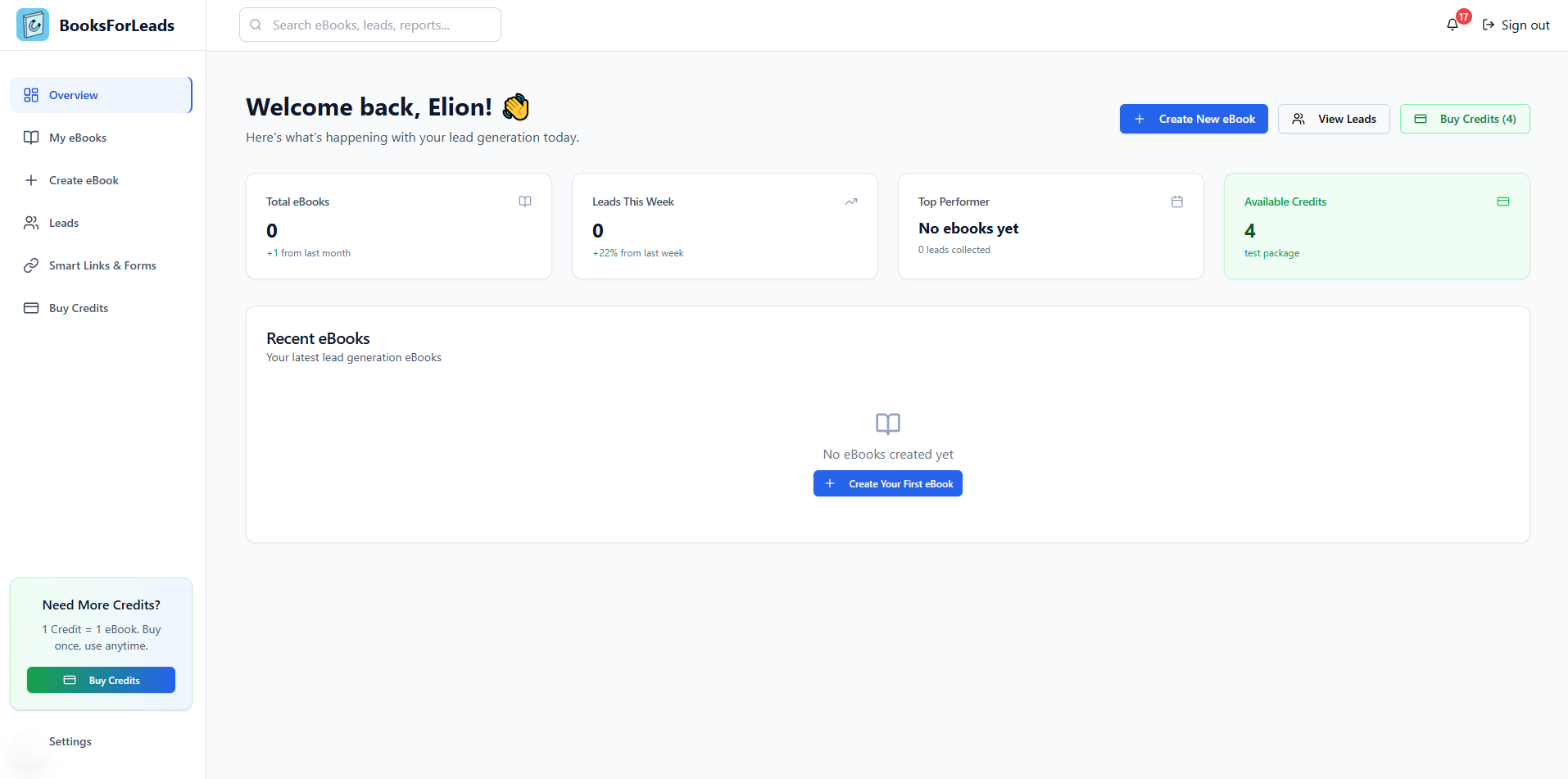
Create Your Educational eBook with BooksForLeads
Most coaches spend 6-8 weeks creating their first eBook. Then they realize they need different versions for different audiences. The thought of doing it again is exhausting.
BooksForLeads changes everything:
Create your first educational eBook in hours, not weeks. When you need variations, create them in minutes. Focus on coaching—let AI handle the heavy lifting.
Why BooksForLeads for Coaches & Consultants:
- ✅ AI understands coaching frameworks and helps you articulate your methodology clearly
- ✅ Built-in templates optimized for high-ticket coaching conversions
- ✅ Track which prospects are reading which sections (know who's most engaged)
- ✅ Create variations for different segments without starting from scratch
How It Works
-
Describe Your Framework - Answer questions about your coaching approach, methodologies, and client results
-
AI Generates Structure - We create comprehensive outline based on what converts for coaches
-
Customize & Edit - Add your case studies, refine voice, adjust examples
-
Professional Design - Choose from coach-specific templates, add branding
-
Publish & Track - Export PDF or publish to web, see who's engaging
Time investment: 2-4 hours vs. 40+ hours doing it yourself
Get Started Today:
Ready to create your Educational eBook that actually converts Coaches & Consultants into clients?
Create professional, conversion-optimized eBooks in minutes, not weeks.
Related Guides:
- Email Sequences That Convert eBook Readers to Coaching Clients
- Landing Page Optimization for Coaches
- How to Price Your Coaching Services